Tange Now
2026.09.17
Statement by CEO Paul Tange on the Decision to Temporarily Suspend Demolition Work on the Former Kagawa Prefectural Gymnasium
旧香川県立体育館の解体工事一時停止決定に寄せて ― 代表・丹下憲孝による声明
September 9, 2026
TANGE ASSOCIATES
I would like to express my heartfelt gratitude to all those involved in the Committee for the Regeneration of the Former Kagawa Prefectural Gymnasium; to everyone who believed in the value of this building and stood up as plaintiffs; to the people of Kagawa Prefecture who have shown such strong support, and to everyone in Japan and around the world who has been following the developments in this matter with concern and interest.
The Takamatsu District Court has now ordered a one-month suspension of demolition work, beginning September 15, in connection with an on-site investigation to assess the building’s seismic performance for the purpose of preserving evidence. I take this decision as an important first step toward protecting the building’s cultural value.
At the same time, however, I cannot help but feel a profound sense of conflict and frustration. This is because Kagawa Prefecture’s current push for demolition is being justified solely on the basis of the seismic assessment that TANGE ASSOCIATES conducted in 2012 at the request of the Prefecture.
The seismic assessment we undertook at that time was by no means a “license to demolish.” It was carried out as the starting point for a plan to renovate and reinforce the building so that its rare architectural and cultural value could be preserved and the building could continue to be used safely for many years to come. We conducted the assessment in the belief that objectively identifying seismic issues and implementing appropriate reinforcement—thereby passing this cultural asset on to future generations—would serve the cultural and social good.
We are grateful that, following the assessment, Kagawa Prefecture took the time to consider how the building might be put to use. However, as soon as the Prefecture determined that the path toward regeneration would be difficult, it relied on our assessment as its sole primary source and concluded that the building should be demolished because it posed a risk of collapse. I fundamentally disagree with using the findings of our assessment as the basis for such a conclusion.
What our assessment demonstrated was the nature of the challenges presented by the building in its existing condition. It did not state that the building was in imminent danger of collapse, nor that reinforcement was impossible. Just as it is impossible in architecture to guarantee that any building will “never collapse,” it is equally impossible to make the extreme assertion that a building is “imminently at risk of collapse” without appropriate grounds. Indeed, leading experts in structural engineering have also made objective technical observations that there is no danger requiring the building to be demolished immediately.
We fully respect the fundamental principle asserted by the Prefecture—that the lives and safety of the people of Kagawa must be protected. However, once this building is demolished, the possibility of preserving and regenerating this invaluable work of world-class architecture will be permanently reduced to zero.
The one-month suspension of demolition work and the on-site investigation provide an excellent opportunity to return to the original purpose with which Kagawa Prefecture entrusted us, and to resume an open discussion based on objective facts. Rather than proceeding on the assumption that demolition is inevitable, I sincerely hope that a process of discussion and explanation will be undertaken that the people of Kagawa—and people around the world—can genuinely understand and accept.
I do not want to see this architectural treasure of the modern era lost in a manner that is contrary to its true value and potential. As an architect, and as someone who understands both the aspirations of my father, Kenzo Tange, and the value of this architecture, I sincerely appeal to everyone for your help.
令和8年9月9日
株式会社TANGE建築都市設計
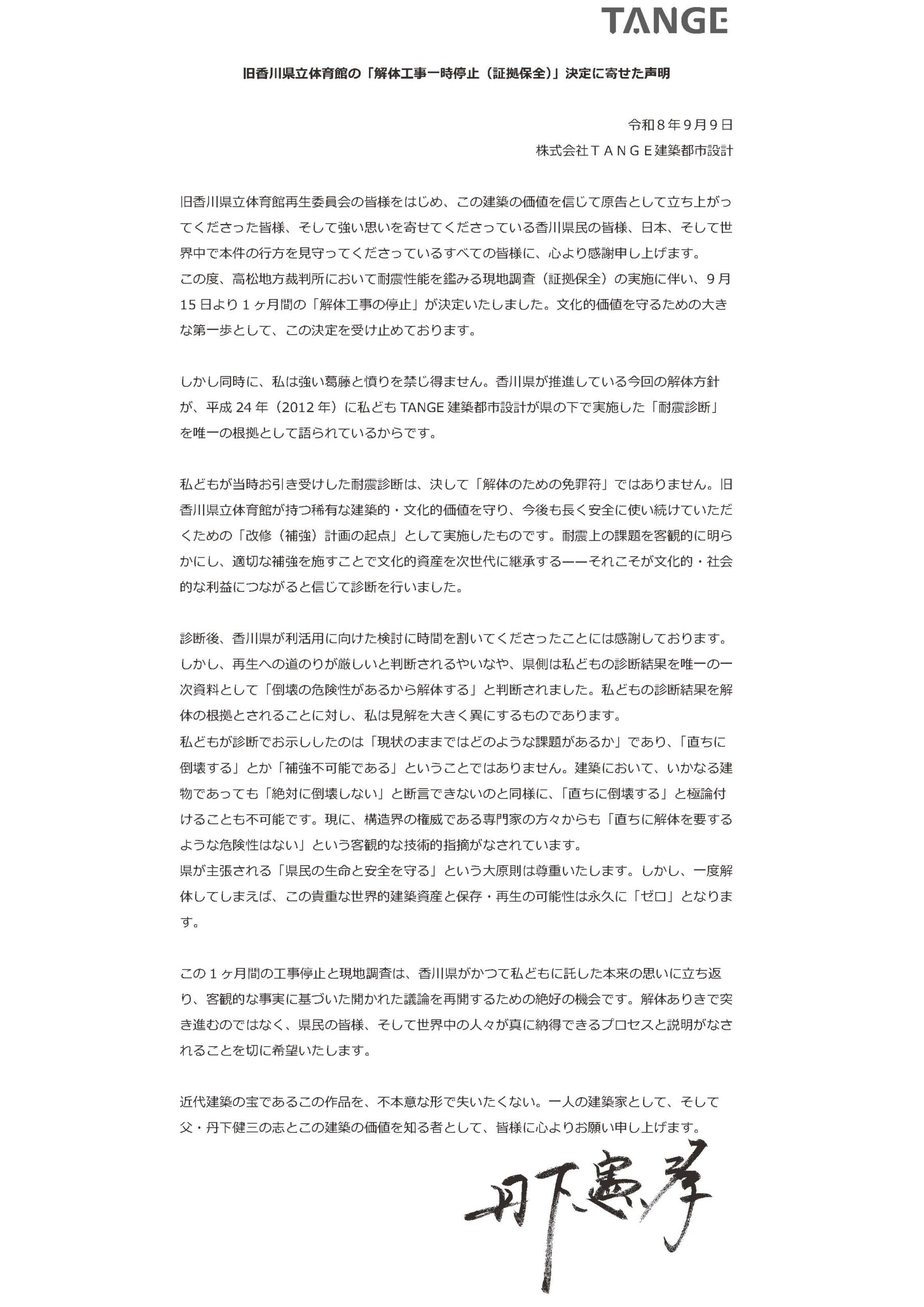
旧香川県立体育館再生委員会の皆様をはじめ、この建築の価値を信じて原告として立ち上がってくださった皆様、そして強い思いを寄せてくださっている香川県民の皆様、日本、そして世界中で本件の行方を見守ってくださっているすべての皆様に、心より感謝申し上げます。
この度、高松地方裁判所において耐震性能を鑑みる現地調査(証拠保全)の実施に伴い、9月15日より1ヶ月間の「解体工事の停止」が決定いたしました。文化的価値を守るための大きな第一歩として、この決定を受け止めております。
しかし同時に、私は強い葛藤と憤りを禁じ得ません。香川県が推進している今回の解体方針が、平成24年(2012年)に私どもTANGE建築都市設計が県の下で実施した「耐震診断」を唯一の根拠として語られているからです。
私どもが当時お引き受けした耐震診断は、決して「解体のための免罪符」ではありません。旧香川県立体育館が持つ稀有な建築的・文化的価値を守り、今後も長く安全に使い続けていただくための「改修(補強)計画の起点」として実施したものです。耐震上の課題を客観的に明らかにし、適切な補強を施すことで文化的資産を次世代に継承する——それこそが文化的・社会的な利益につながると信じて診断を行いました。
診断後、香川県が利活用に向けた検討に時間を割いてくださったことには感謝しております。しかし、再生への道のりが厳しいと判断されるやいなや、県側は私どもの診断結果を唯一の一次資料として「倒壊の危険性があるから解体する」と判断されました。私どもの診断結果を解体の根拠とされることに対し、私は見解を大きく異にするものであります。
私どもが診断でお示ししたのは「現状のままではどのような課題があるか」であり、「直ちに倒壊する」とか「補強不可能である」ということではありません。建築において、いかなる建物であっても「絶対に倒壊しない」と断言できないのと同様に、「直ちに倒壊する」と極論付けることも不可能です。現に、構造界の権威である専門家の方々からも「直ちに解体を要するような危険性はない」という客観的な技術的指摘がなされています。
県が主張される「県民の生命と安全を守る」という大原則は尊重いたします。しかし、一度解体してしまえば、この貴重な世界的建築資産と保存・再生の可能性は永久に「ゼロ」となります。
この1ヶ月間の工事停止と現地調査は、香川県がかつて私どもに託した本来の思いに立ち返り、客観的な事実に基づいた開かれた議論を再開するための絶好の機会です。解体ありきで突き進むのではなく、県民の皆様、そして世界中の人々が真に納得できるプロセスと説明がなされることを切に希望いたします。
近代建築の宝であるこの作品を、不本意な形で失いたくない。一人の建築家として、そして父・丹下健三の志とこの建築の価値を知る者として、皆様に心よりお願い申し上げます。
-scaled.jpg)